
Interview: “Lupin III – La Merveille”, with Kid Toussaint & José Luis Munuera
Any text that is noted with a (W.N.) means that this was a note added by the original author – in this case, Guillaume!
On September 25th, 2026, the graphic novel Lupin III – La Merveille is coming out in French speaking countries, as part of the “Kana Classics” collection.
While European artists had already taken a stab at the monkey-faced thief in the past with the short-lived Lupin III Millenium comics in Italy, La Merveille is the first original Lupin III story to be produced and published in France. To celebrate this momentous occasion, we’ve sat with author Kid Toussaint and artist José-Luis Munuera who graciously told us about how “The Wonder” was born.
We would like to give our thanks to Mrs Stéphanie Nunez et Mr Nathan Poquet for their help in making this interview possible. We also send our most sincere sympathies to the friends and family of Belgian editor and founder of Kana Yves Schlirf, who passed away on September 12th, 2026.
How did you become attached to the project?
Munuera: Around 10 years ago, Jean-David Morvan (French comic author, worked with Munuera on Spirou, W.N.) and I wanted to make a Lupin comic together. I even made some preliminary sketches, but we met a wall when trying to unravel all the rights issues. Sometime later, Chrystelle from Kana publishing contacted me to see if I was interested in participating in their “Kana Classics” collection. Naturally, I brought up Lupin. It took Chrystelle two years to solve the legal issues and make this novel a dream come true.
Toussaint: Munuera sought me out. He thought a young author would suit the job, as Lupin and his friends often behave more like teenagers than adults. I was planning on working on other manga / anime titles for the “Kana Classics” collection, but after writing La Merveille, I think Lupin is the best fit for me.
Were you already familiar with Lupin III before starting to work on the album, and if so when was your first exposure to the franchise?
Munuera: I grew up on the first two TV series back when they were broadcasted in Spain. I had also watched the first two animated films. What I love about Lupin III is the absence of any real consequences, this sense of pure freedom and how it’s got its own logic, completely different from the real world.
Toussaint: I had watched Part 2 when it showed up on TV (broadcasted on France 3 in 1985 as Edgar Détective Cambrioleur, W.N). It wasn’t my favourite series back in the day… I preferred Sherlock Hound, and I wanted to be like Holmes when I grow up. The truth is that we more often grow up to become Moriarty… or indeed Lupin (laughs)!
Had you received directions from the owners of Lupin III to follow, like for example, the colour of Lupin’s jacket?
Munuera: We have shown the utmost respect for the source material and made a highly detailed plan of what we wanted to do. The copyright owners gave us plenty of creative room, with a few exceptions - the jacket colour in particular. We originally wanted to use the green jacket because it’s the one most French viewers are familiar with, due to the success of The Castle of Cagliostro, and our colourist loves Miyazaki’s film. Still, the red jacket turned out to suit the stories spirit quite well. We couldn’t include any recognizable trademarked brand, as to avoid legal issues. That’s the reason why Lupin doesn’t drive a real Fiat 500 nor is holding a Walther P38 in his hand on the cover (interestingly, Lupin had once traded his P38 for a P99 in the Lupin III Y manga by Masatsuki Yamakami, W.N).
Toussaint: As for the jacket, I’m colour-blind, so it didn’t bother me at all (laughs)! We were told to be careful in how Goemon held his sword, as they were quite particular on that. We also had to fight for our take on Fujiko. As soon as they noticed we gave her a generous mane of hair, they were sold!
Munuera: We also had to be very careful with our rendition of Tokyo. I originally used the pictures I took while on holiday in Japan as references, but I was told to avoid including any recognizable brands or addresses.
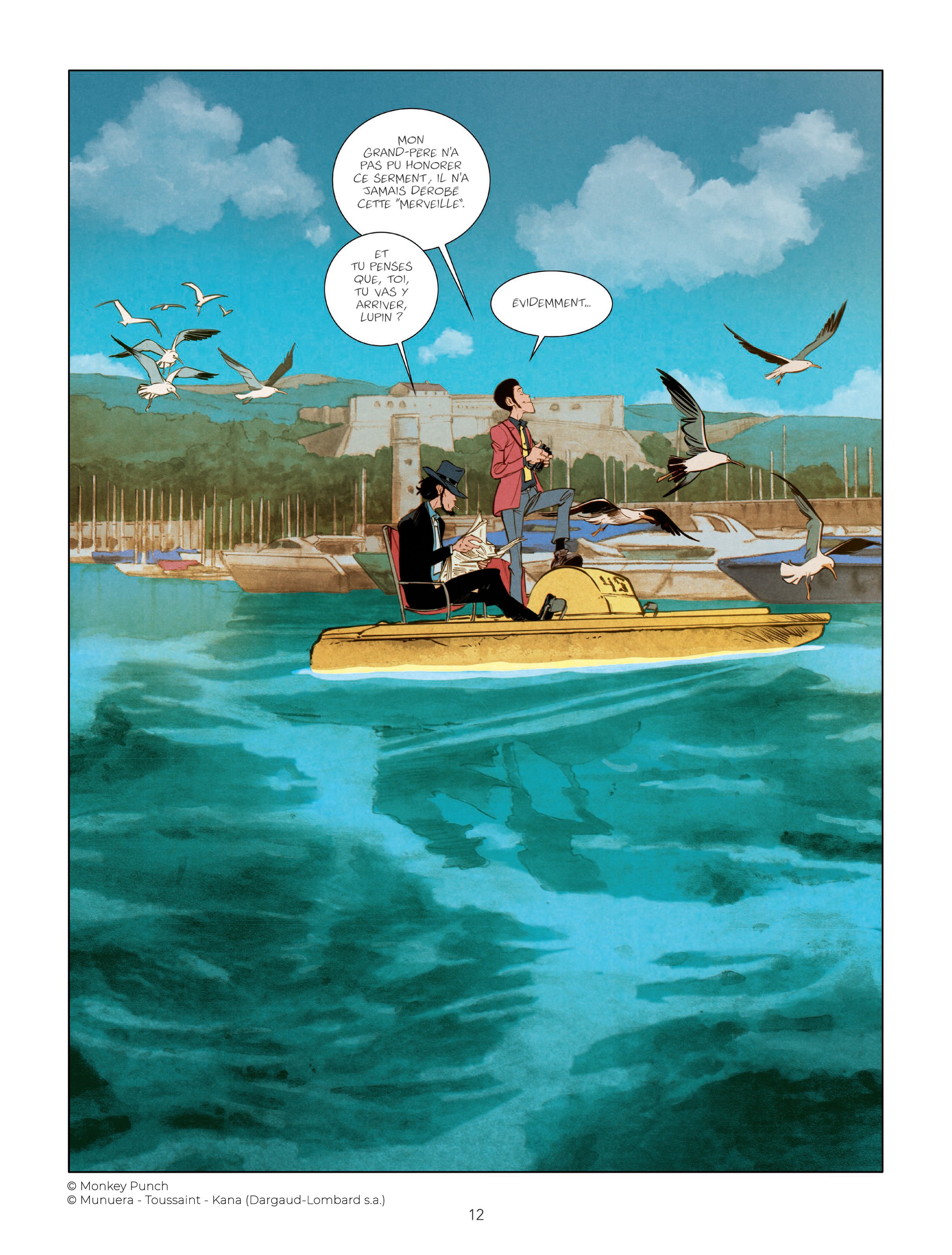
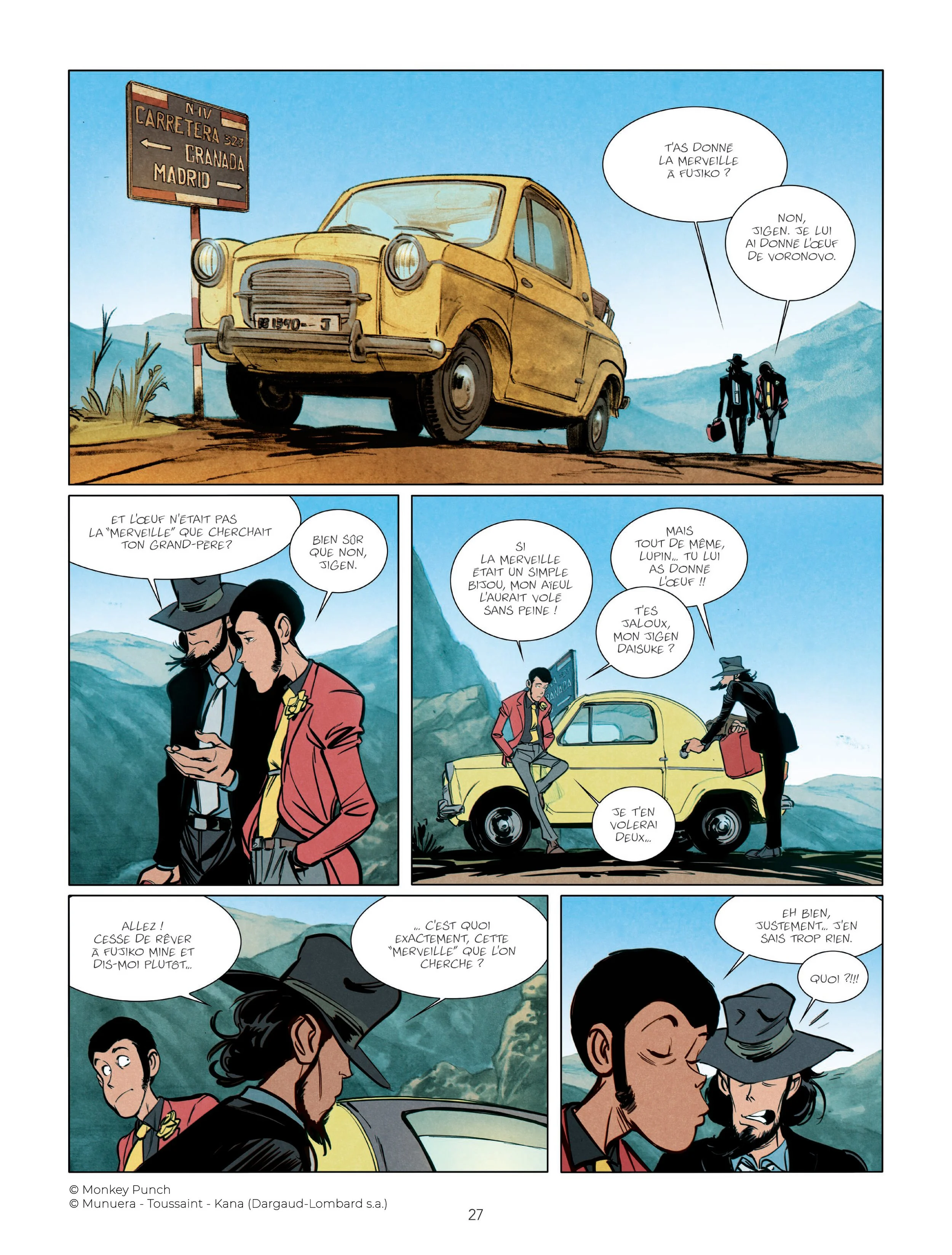
Lupin and his friends have been depicted in a myriad of styles. Which version(s) of the characters inspired you the most for the album?
Munuera: Having grown up with the first two series, I really wanted to stay close to the globe-trotting aspect of Part 2. Most of the characters have strong Western influences, with stylistic sensibilities that are already pretty close to mine. As for the timeline, we see La Merveille as fitting somewhat in-between The Mystery of Mamo and The Castle of Cagliostro. Our opening scene makes a few nods to the latter. That’s why our story takes place in the late 1970’s, and the look of it, from the architecture to the vehicles reflects that.
Toussaint: We allowed ourselves a few anachronisms, like the scenes taking place at Alcatraz penitentiary (it closed on March 21st, 1963, W.N.). Luckily for us, the franchise’s treatment of History is pretty loose in general.
Like in some episodes, TV specials and movies in the franchise, the original Arsène Lupin plays a big part in your story. What motivated you in exploring this connection?
Munuera: We thought it was a good way to complete the circle of influences, since we make a French comic based on a Japanese franchise itself inspired by Western literature and pop culture. It added some meta-textual quality to it all.
Toussaint: It allowed us to add an emotional stake in this treasure hunt, as Lupin III tries to succeed where his grandfather had seemingly failed. We also wanted to pay homage to the serialized novel format in which Arsène Lupin was originally published.
The story also features a secondary villain with inhuman abilities. It’s a classic element of the franchise, but how did you come up with the character?
Toussaint: I’ll admit I don’t remember how we come up with him, but we really wanted to include that kind of strong and silent henchman archetype, with a special weapon or physical trait. The kind of character you find in a classic James Bond flick, like Oddjob, or Jaws.
Which character was your favourite to write and / or draw?
Toussaint: It’s like asking me to choose between my own children! With Lupin III, it’s really all about group dynamic. I’ll admit that Jigen is very charismatic - we would all love to be like him. I had a hard time writing for Goemon at first, but he grew on me because of how anachronistic he is to everything and everyone around him. He gave me room to breathe, so to speak.
Munuera: Definitely Lupin for me. He is so loveable and mischievous. He’s always one step ahead of everyone, friends and foes alike. He reminds me a bit of the 10th Doctor (David Tennant) from Doctor Who. Oh, and I also love Zenigata.
Toussaint: We really love Zenigata, this beautiful loser who always fails but never gives up, not unlike Wile E Coyote desperately trying to catch the Roadrunner. Even though we know he’ll surely fail, we can’t help but wish he succeeds one day. That’s why we made him the main character in the Tokyo portion of our story. We wanted to humanize him a bit.
Which character was the hardest to write and / or draw?
Toussaint: That must be Fujiko. She often comes off as hypersexualized and it’s not really something we’re allowed to showcase in a Franco-Belgian comic these days (that depends on the publisher and targeted audience, W. N.). I focused more on the emotional side of her relationship with Lupin, while keeping their “cat & mouse” dynamic intact. That’s why Fujiko doesn’t show up much in the album, only coming back in the climax once Lupin has done all the dirty work of finding the treasure’s location.
Munuera: I would also say it’s Fujiko. It was hard for me to draw her, as her design changes a lot from a series or movie to another. So, I based my designs on my earlier sources of inspiration, like Disney, and of course my wife, as she’s my ideal woman!
The “Kana Classics” albums are destined to be One-Shots. However, would you be interested in making a second Lupin III adventure?
Munuera: It’s not entirely up to us, but I would be interested.
Toussaint: Same, I really had a blast writing for these characters!
Would you like to see your album, as well as others from the “Kana Classics” collection, being translated and distributed abroad?
Toussaint: Since we don’t own any of the characters, it’s not up to us to decide whether it can be translated and distributed abroad, but it would be wonderful if the rest of the world could read it.
Munuera: I’d be happy to see La Merveille get distributed in Italy in particular. Lupin III is extremely popular there! That will all depend on the album’s success.
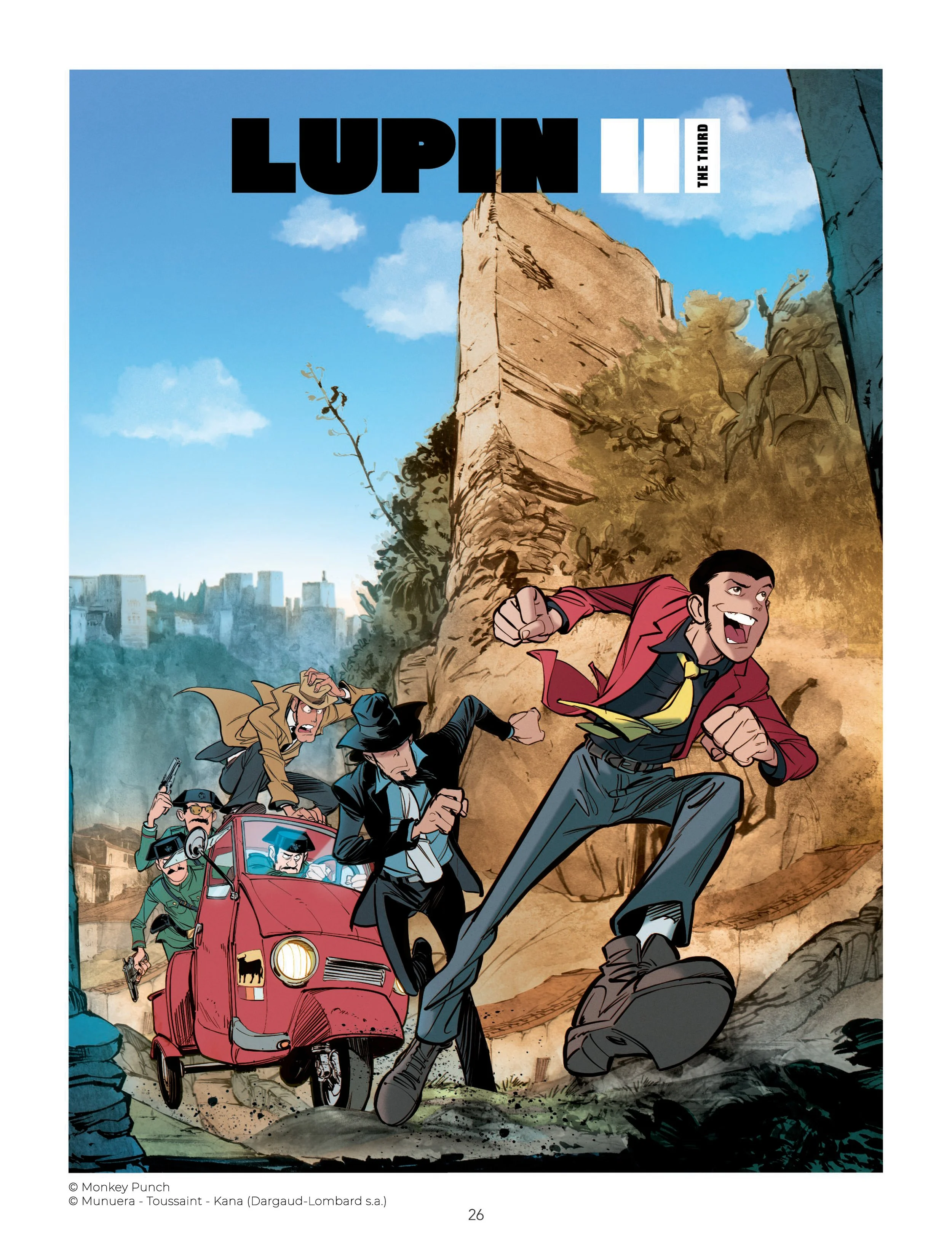
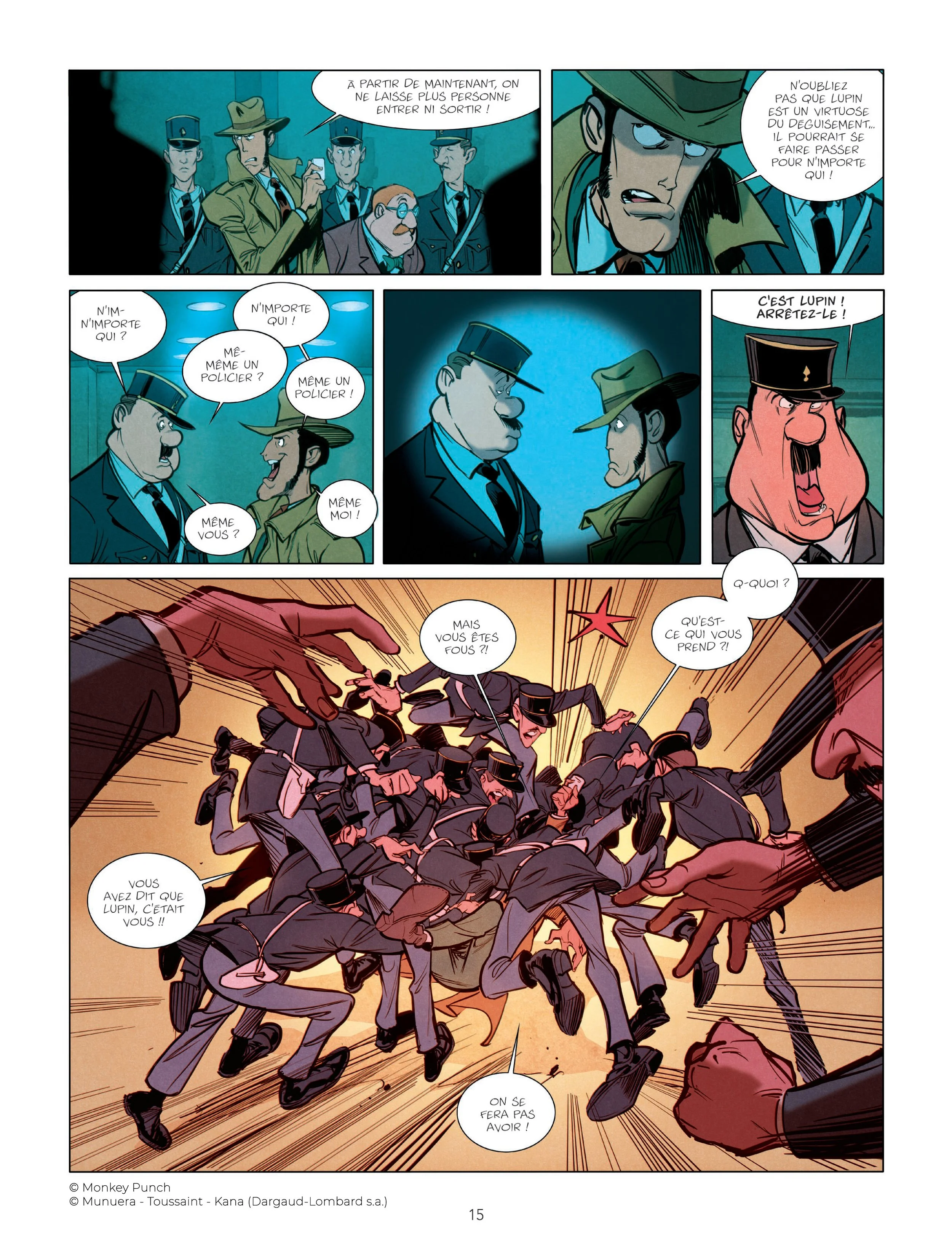
Lupin III – La Merveille, by Kid Toussaint & José-Luis Munuera, Kana publishers, is coming out on September 25th, 2026. Both a standard and collector’s edition will be available in all French speaking countries. You can order the novel via the Kana website by clicking here.
A huge thanks to Guillaume for organising, conducting, and translating this interview. If you would like to support Guillaume and his stellar work, please consider dropping by his Ko-Fi page.
